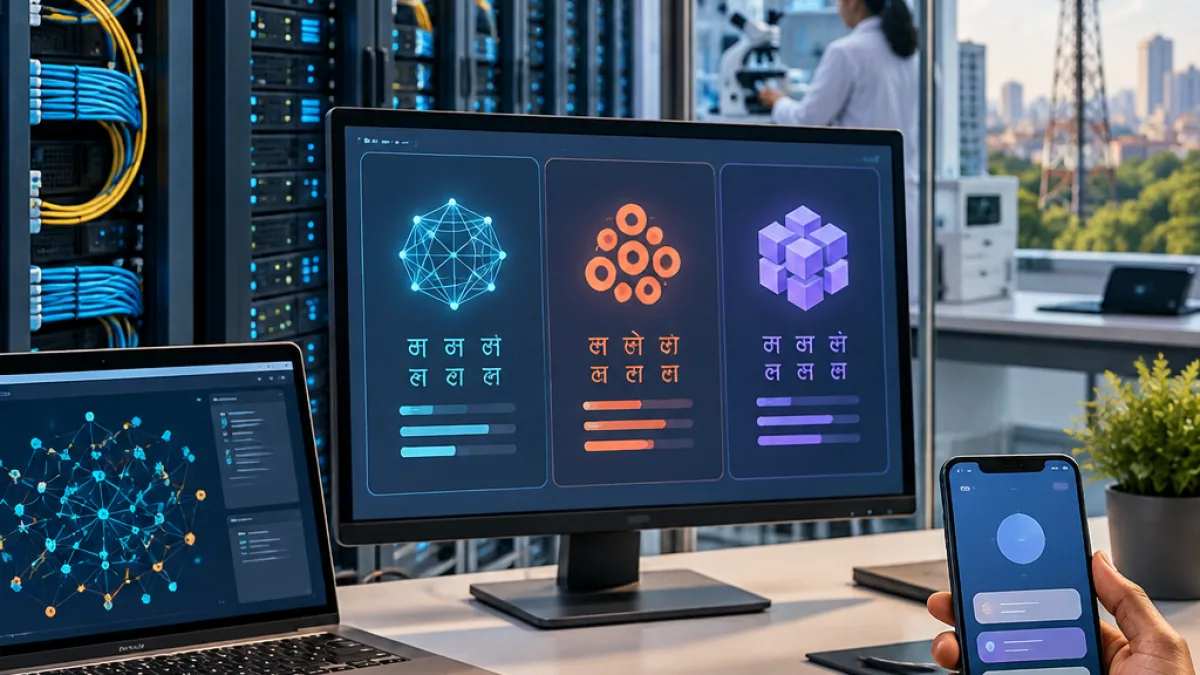
The IndiaAI Mission, under the Ministry of Electronics and Information Technology (MeitY), has released three indigenous foundation models aimed at expanding India’s capabilities in multilingual and locally deployable artificial intelligence. The models are EKA-1, developed by Soket Labs Technology and Research Private Limited, and Dhīr 2B and Dhīr 5B, developed by ZenteiQ AiTech Innovations.
The models were unveiled at a press event in New Delhi on 3 November 2026, in the presence of MeitY Secretary S. Krishnan, senior officials from MeitY and IndiaAI, and representatives of the two companies. The release was made under the IndiaAI Innovation Centre pillar, which is intended to support the development of home-grown AI systems for use by researchers, businesses, government bodies and other organisations.
What the three models offer
| Model | Developer | Details stated in the release |
|---|---|---|
| EKA-1 | Soket Labs Technology and Research Private Limited | 26.3 billion parameters; trained on approximately 7.5 trillion tokens across all 22 Scheduled Indian languages and English; intended for mathematics, coding, reasoning and agentic use |
| Dhīr 2B | ZenteiQ AiTech Innovations | Open-source multilingual assistant model supporting English and 10 Indian languages |
| Dhīr 5B | ZenteiQ AiTech Innovations | Open-source multilingual assistant model supporting English and 10 Indian languages |
The release positions EKA-1 as a larger general-purpose model with applications extending beyond text generation. Its stated areas include mathematics, code, reasoning and “agentic” use, a term generally used for systems that can carry out multi-step tasks. However, the announcement does not provide independent benchmark results, evaluation scores, latency figures or details of the hardware needed to run the model. The parameter count and training-token figure therefore describe the model’s scale, but do not by themselves establish how it will perform against other systems.
Dhīr 2B and Dhīr 5B are described as open-source assistants designed for secure, on-premise and offline-capable deployment across critical sectors. That positioning could matter to Indian organisations that cannot send sensitive information to a public cloud service, although the release does not specify the licence terms, supported hardware, model weights, deployment procedure or the 10 Indian languages included. Those details will be important for developers and institutions assessing whether the models can be used in production.
“The development of such indigenous models strengthens India’s technological and strategic autonomy in Artificial Intelligence. It also opens up opportunities to improve productivity and efficiency across government, industry, research and education.”
— S. Krishnan, Secretary, Ministry of Electronics and Information Technology
MeitY said resources from the IndiaAI Mission have supported the creation of EKA-1 and Dhīr, with each model addressing different use cases. The ministry also pointed to AIKosh as a platform through which the models can be made accessible to researchers, students, innovators and the wider public. The wording indicates a route for access, but does not state that all three models are already available for public download or use.
For Indian users, the significance of the release lies in its focus on local languages and deployment within Indian organisations rather than only on consumer chatbots. Models that can process Indian-language content and operate without a continuous internet connection could be relevant to government services, education, research and sectors handling confidential records. Their practical value will depend on access, licensing, language quality, safety testing, documentation and independent evaluations—information that was not included in the announcement.
- EKA-1 has 26.3 billion parameters and was trained on approximately 7.5 trillion tokens.
- Dhīr 2B and Dhīr 5B are open-source models designed for multilingual, on-premise and offline-capable use.
- AIKosh may provide access for researchers, students, innovators and the public, but availability details were not specified.