Nothing will launch Ear (note) on 8 December 2026, introducing earbuds designed to record both phone calls and in-person conversations. The product was demonstrated by co-founder Carl Pei and is positioned as a wearable alternative to dedicated AI recorders, although several important details remain undecided before its formal debut.
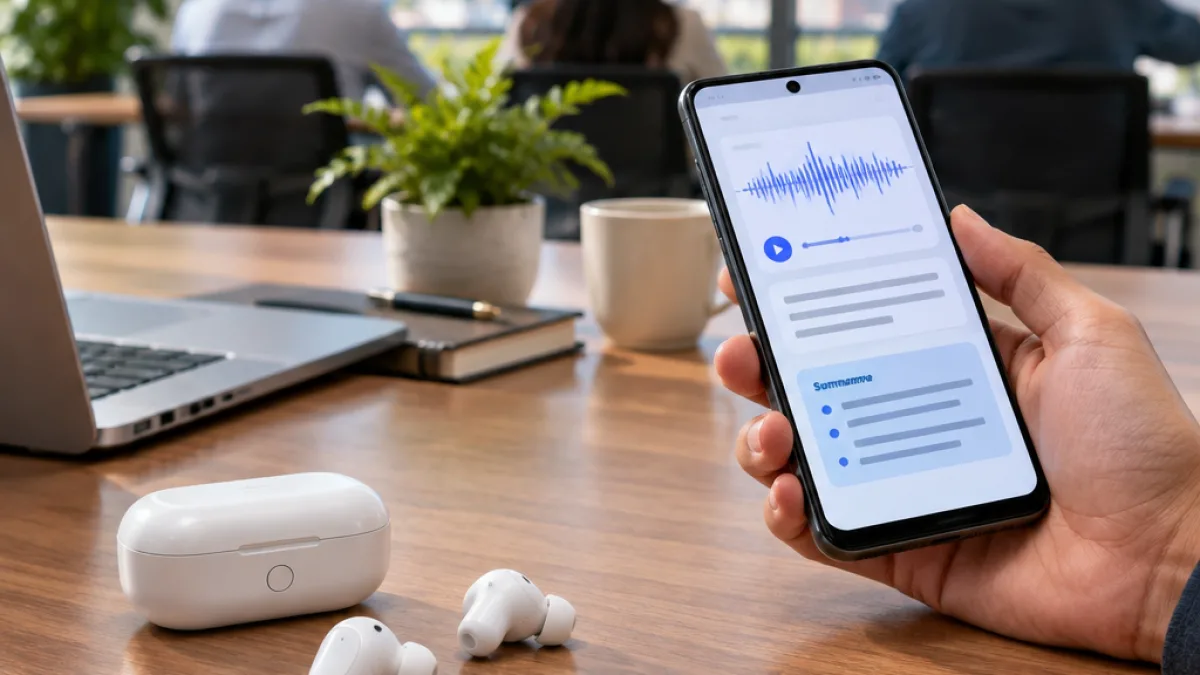
The system divides recording between the earbuds and their charging case. Microphones in the case capture face-to-face meetings, while the earbuds are used for phone calls. A physical Talk button on the case lets the user record their own voice, and Nothing has indicated that the control could be assigned other functions in the future.
One device for meetings and calls
Audio captured through the system is managed in a companion app. The application organises recordings, converts them into text and creates AI-generated summaries. Ear (note) will also work with multiple AI agents, alongside a simpler voice-control system developed by Nothing for two-way prompts.
| Feature | What Nothing has shown |
|---|---|
| Meeting recording | Microphones in the charging case |
| Call recording | Earbuds |
| Voice control | Dedicated Talk button on the case |
| Audio processing | Transcripts and AI-written summaries in a companion app |
| Launch date | 8 December 2026 |
The approach differs from many existing AI recording products, which generally concentrate on either in-room conversations or calls. Nothing is attempting to combine both use cases in one pair of earbuds. That could make the product relevant to people who regularly move between meetings and phone conversations, but its usefulness will depend on how the recording, transcription and summary features work in practice.
“It's a very sensitive space, so we were extra careful to not take any risks,” Carl Pei said.
Privacy is a central consideration because Ear (note) can record in more than one setting. Nothing said it has privacy credentials equivalent to rival recording devices and has engaged law firms to assess potential risks and protections. The company has also created a London-based data and security team to support development of the product.
Price and processing remain open questions
Nothing has not announced the price of Ear (note). It has also not clarified whether transcription will run on the earbuds or case, or depend on cloud processing, and has not confirmed whether users will need a subscription. Those details will be important for buyers in India, particularly because they affect recurring costs and how recorded conversations are handled.
Nothing’s product strategy also extends beyond a single in-house assistant. Pei said the company sees an opportunity to provide hardware for an ecosystem of competing AI agents, rather than relying only on its own software. He also expects near-term demand for consumer AI devices to remain limited and said he does not foresee “any iPhone moment for consumer AI anytime soon”.
Ear (note) follows smaller recording-related additions in Nothing’s existing earbuds. The company’s Ear (3a), launched in July, includes Audio Snapshot for saving a short clip of listened-to audio and supports call recording. The new product represents a broader attempt to build transcription into a wearable people may already carry, but its price, subscription terms and data-processing model are still pending.