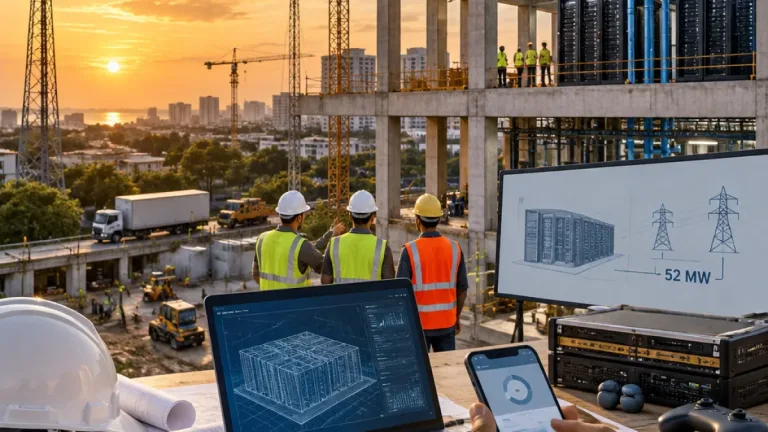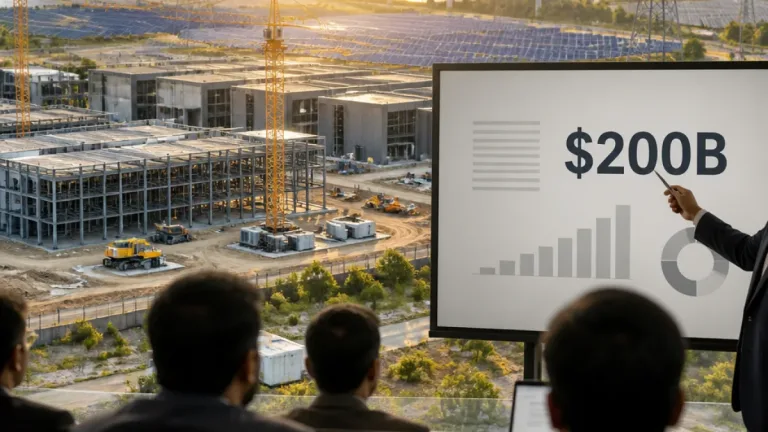

India’s installed data centre capacity could increase five-fold to 7.5 gigawatts (GW) by March 2030, according to a report released by Crisil on Tuesday, 3 November 2026. The expansion is expected to attract more than ₹3 lakh crore in investment over the four financial years ending March 2030, as generative artificial intelligence (GenAI), enterprise digitalisation and data consumption increase demand for computing and storage infrastructure.
The rating agency described the sector as entering an “investment super-cycle”, but said the outcome will depend on whether developers can secure power connections, obtain regulatory approvals and execute large projects without delays. These factors will also influence the credit quality of data centre companies undertaking the capital-intensive expansion.
“The surge is being driven by generative artificial intelligence (GenAI) led computing demand, enterprise digitalisation and rising data consumption. The pace of this expansion and credit quality of the data centre developers will hinge on timely power connectivity, regulatory approvals and disciplined project execution,” Crisil said.
Long-term contracts reduce demand risk
Crisil said demand visibility is relatively strong because nearly half of the capacity planned for the coming period has already been committed through long-term contracts. Agreements with hyperscalers, supported by cloud adoption and increasingly intensive GenAI workloads, can provide revenue certainty before facilities become operational.
That advance commitment reduces the risk of developers building capacity without customers. However, the scale and speed of the proposed construction programme will raise execution requirements. Delays in land development, grid access, permissions or project commissioning could affect the ability of operators to begin earning from the new capacity.
| Measure | Projection or assessment |
|---|---|
| Installed data centre capacity | 7.5 GW by March 2030 |
| Planned investment | More than ₹3 lakh crore through March 2030 |
| Upcoming capacity covered by long-term contracts | Nearly half |
| Upcoming capacity referenced by Crisil | About 6 GW |
Power infrastructure is a key constraint
About three-fourths of the upcoming capacity of around 6 GW is expected to be developed in Visakhapatnam, Mumbai and Hyderabad. The concentration of projects in these locations could put additional pressure on local electricity infrastructure and make timely grid connectivity particularly important.
- By fiscal 2030, data centre capacity in Visakhapatnam could be equivalent to around 80 per cent of the city’s current peak power demand.
- In Mumbai, the comparable figure could reach around 60 per cent.
- In Hyderabad, the capacity could equal around 20 per cent of current peak power demand.
Crisil’s assessment means that data centre growth is not only a real estate or cloud-sector issue. The planned facilities will require substantial, reliable electricity supply, making coordination with power utilities and authorities central to project delivery. For users and businesses in India, additional capacity could support cloud services, AI applications and digitally delivered services, but the report indicates that those benefits depend on infrastructure being commissioned as planned.
India’s cost position supports expansion
India also remains attractive to hyperscalers because its development costs are around one-fifth lower than in several competing Asia-Pacific markets. Crisil attributed this difference to comparatively competitive land, construction and labour costs. Lower power tariffs further support the market, with data centre rentals estimated to be 30-35 per cent below those in peer markets.
The availability of large campuses powered by renewable energy is another factor in India’s favour, particularly for hyperscalers pursuing sustainability targets. However, lower costs and strong demand will not by themselves remove the operational constraints identified by Crisil. Power availability, approvals and disciplined construction will determine how much of the projected 7.5 GW becomes usable capacity by March 2030.