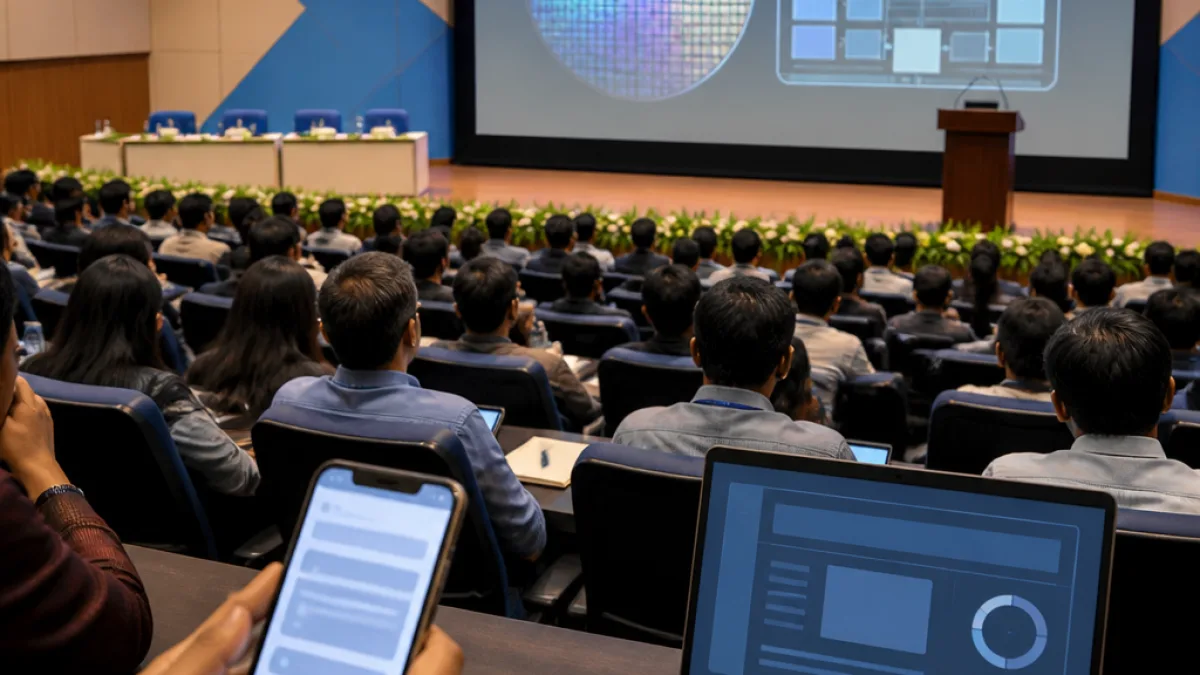
Dr Priti Adani, President of Adani University, has urged tighter collaboration between industry and academia to develop the skilled workforce India needs for its semiconductor ambitions. She spoke on 24 October at the 'Conclave on Hardware, Innovation, Processing & Semiconductor Technologies (CHIPS) 2026', organised by Adani University in collaboration with IIT Mandi, the VLSI Society of India and law firm Cyril Amarchand Mangaldas.
“The true measure of our technological progress will not be how intelligent our machines become. It will be how wisely we develop and use human intelligence to build a better future,” Dr. Priti Adani said.
What happened at CHIPS 2026
The conclave brought together executives and experts from semiconductor and related firms — including Qualcomm, NXP Semiconductors, Micron Technology, Synopsys and Infineon Technologies — as well as legal specialists from Cyril Amarchand Mangaldas. According to the organisers’ statement, keynote addresses covered wireless technology, semiconductor design, memory and storage, power systems and legal services. Three panel discussions targeted:
- The Future of Semiconductor Design in India — ways to strengthen domestic design capabilities.
- Semiconductor Manufacturing: Shaping India's Technological Future — manufacturing’s role in national technology policy and industrial strategy.
- Career Opportunities in the Semiconductor Ecosystem — emerging roles, skill requirements and career pathways for students and professionals.
Why this matters for India
Speakers at CHIPS 2026 framed the conversation around the broader objectives of the India Semiconductor Mission (ISM), which has been driving investment and policy attention to chip design, manufacturing and packaging. The conclave emphasised that building wafer fabs alone will not create a resilient domestic semiconductor ecosystem: design engineers, test and packaging specialists, verification experts and power-system engineers are equally critical.
Panel discussions focused on aligning research and technical education with industry needs — a recurring policy concern as India scales capacity across the semiconductor value chain. The presence of global vendors and EDA (electronic design automation) and IP suppliers underlined demand for specialised skills that universities and vocational programmes must supply.
Implications for students, institutes and industry
The statements at the event point to several practical shifts that matter to Indian stakeholders:
| Stakeholder | Expected focus |
|---|---|
| Universities | Curriculum alignment with chip design, verification and packaging; stronger industry partnerships |
| Industry | Skills development programmes, internships and collaborative research with academic centres |
| Students and professionals | Emerging career pathways in VLSI, EDA tools, memory technologies and power systems |
The conclave also signalled the legal and regulatory dimensions of the ecosystem by involving a leading law firm, reflecting that commercial agreements, IP arrangements and policy incentives will shape how partnerships form.
While CHIPS 2026 underscored alignment between education and industry as a priority, the statement did not specify new government policy measures, funding commitments or concrete university–industry programmes. The discussions, as described by the organisers, are part of ongoing efforts to translate the India Semiconductor Mission’s policy momentum into a sustained talent pipeline for design, manufacturing and packaging roles.
For Indian technology policy, the event reinforces a widely held view among industry and academic stakeholders: hardware manufacturing ambitions require parallel investment in human capital and institutional collaboration if India is to develop competitive capabilities across the semiconductor value chain.