Canva has introduced Canva Craft, the design platform’s first proprietary image generation model built by its research team and announced on 25 October 2026. The company says Canva Craft was developed after its acquisition of Leonardo.ai in 2024, with researchers from Leonardo.ai contributing to the project.
How the model works
Canva describes Canva Craft as a two‑stage system. In the first stage the model interprets a user’s prompt and plans composition details such as spatial relationships, relative scale, visual hierarchy and text. In the second stage it generates the image output. Canva says the approach aims to produce accurate object details and legible text while allowing precise edits that do not alter other parts of an image.
Availability and integrations
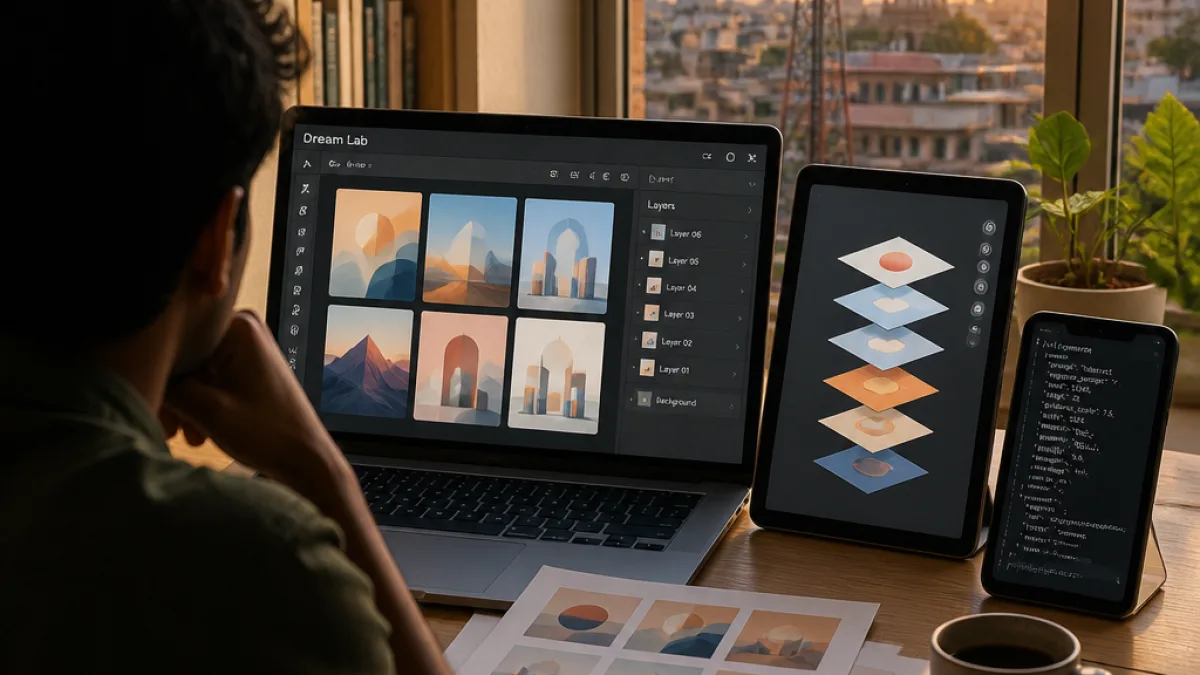
Canva says Canva Craft is available to all users through the Dream Lab tab and is also accessible via the Canva API. The company plans support for the model in ChatGPT and Gemini through Canva’s MCP. Canva also said it will offer two lower‑cost variants, named Craftfast and Craft‑ultrafast, at a later date.
Training data and product intent
Rather than relying primarily on photographs, Canva trained Craft on human‑designed templates from its library, including posters, social posts, presentations, infographics and menus. Canva says this means generated images are intended to be convertible into layered designs via Canva Magic, its image‑to‑design tool.
- Maximum output resolution: up to 2K
- Aspect ratios: 30 supported
- Primary training material: Canva’s human‑designed templates (posters, presentations, infographics, menus, social posts)
- Availability: Dream Lab tab and Canva API; ChatGPT and Gemini support planned via MCP
- Planned variants: Craftfast and Craft‑ultrafast coming soon
Canva framed the model as a way to gain control over quality, speed and cost for its image generation needs. The company positioned Craft to compete with image models from other large technology firms named in the announcement.
What this means for creators and developers
By training on design templates rather than photographic datasets, Canva Craft is presented as optimised for producing assets that fit directly into the platform’s layered design workflow. Canva’s claim that generated images can be converted into editable designs via Canva Magic suggests an emphasis on integration between generative imagery and the company’s existing design tools. The availability of an API also signals that Canva intends to make Craft usable by third‑party applications and developer workflows.
Canva said the release follows a lowered 2026 growth forecast that analysts tied to a valuation adjustment, and positions the company to control model quality, speed and costs internally.