
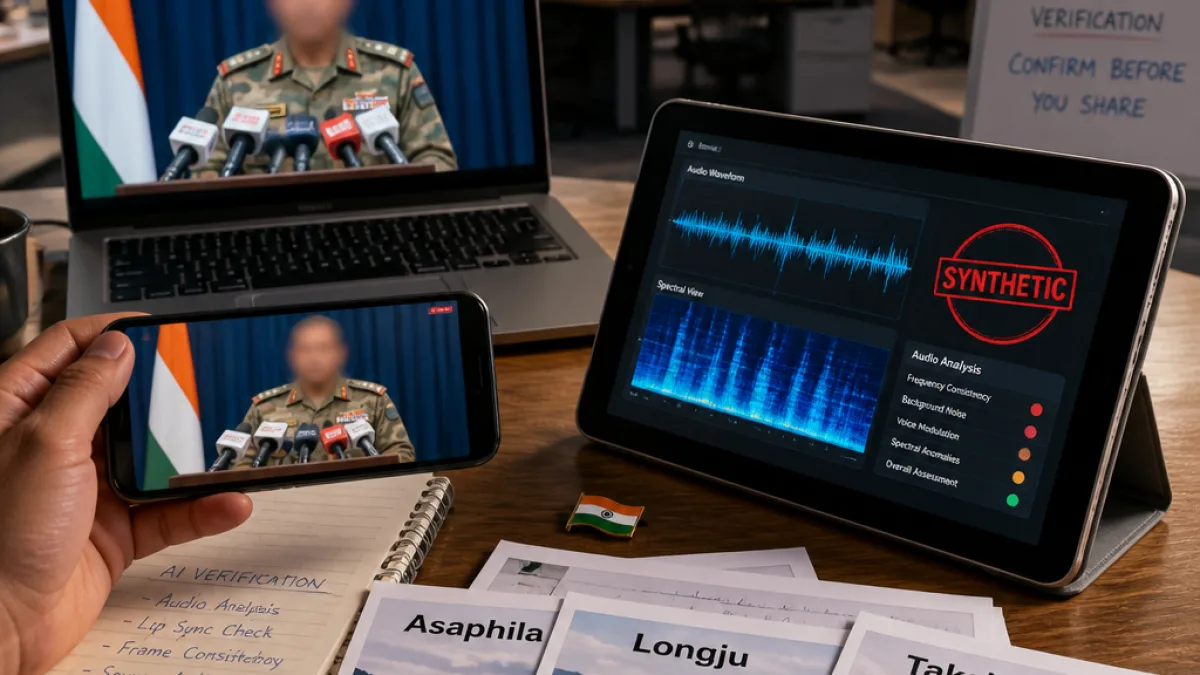
The Indian Army’s official fact‑checking unit has exposed a digitally manipulated video that falsely attributed remarks about Chinese territorial gains in Arunachal Pradesh to Lieutenant General Girish Kalia. The Army said the clip used synthetic techniques — including AI‑enabled lip‑syncing and voice cloning — placed over archival footage to create a misleading narrative and sow panic.
“A digitally altered video is being circulated with fabricated remarks attributed to Lt Gen Girish Kalia, claiming that China has taken control of Asaphila, Longjou and Taksing Circle in Arunachal Pradesh and that the Indian Army has been denied essential supplies.” — INDIAN ARMY FACT CHECK (@MythbusterXX)
What the Army traced and why it matters
Investigators identified the base footage as a press briefing delivered by then‑GOC 28 Infantry Division, Major General Girish Kalia, in Kupwara, Jammu & Kashmir on 27 October 2023. The Army said the original briefing covered infiltration attempts across the Line of Control and made no reference to territories in Arunachal Pradesh or to shortages of supplies.
The unit described the manipulation as a combination of an old military briefing, AI‑generated lip and voice edits, and false attribution of remarks — a repeated pattern in digitally amplified disinformation. The Army used the X post to urge the public to verify original speeches before sharing, and to flag the incident as an instance of “military disinformation” created using “synthetic‑generated technology.”
Implications for India’s information environment
The episode underlines two intersecting challenges for India: the growing technical sophistication of generative AI tools that can produce realistic audiovisual forgeries, and the rapid social‑media amplification that turns manipulated clips into political or security crises. Security agencies, journalists and platform moderators are all affected because synthetic media can repurpose genuine archive footage and insert fabricated claims without clear provenance.
- Source footage identified: press briefing from 27 October 2023 in Kupwara, Jammu & Kashmir.
- Tech used: AI lip‑syncing and voice cloning over archival video.
- Targets and claims: fabricated admission that China controls Asaphila, Longju and Taksing Circle and alleged denial of supplies to Indian troops.
The Army’s public clarification adds to a growing list of official responses in India to synthetic media. For media organisations and platform operators, the incident is a reminder to verify timestamps, cross‑check original recordings and apply forensic checks before republishing. For policymakers and national security bodies, such episodes feed into ongoing debates about regulation, platform responsibility and the need for national capabilities to detect and attribute synthetic content.
The Army also tagged several government fact‑check and security handles in its post, signalling coordination with other official verification channels. The post used the hashtags #DetectTheDeepfake and #SyntheticGeneratedInformation to highlight the method of manipulation and to encourage users not to amplify the clip.
As generative models become easier to use, authorities and civil society in India face a fast‑moving threat: convincing evidence that a clip is fake may exist, but it can take time to trace the origin and to persuade social‑media platforms to limit spread. The Army’s swift public rebuttal in this case aimed to halt further circulation and to provide a clear reference to the original footage.