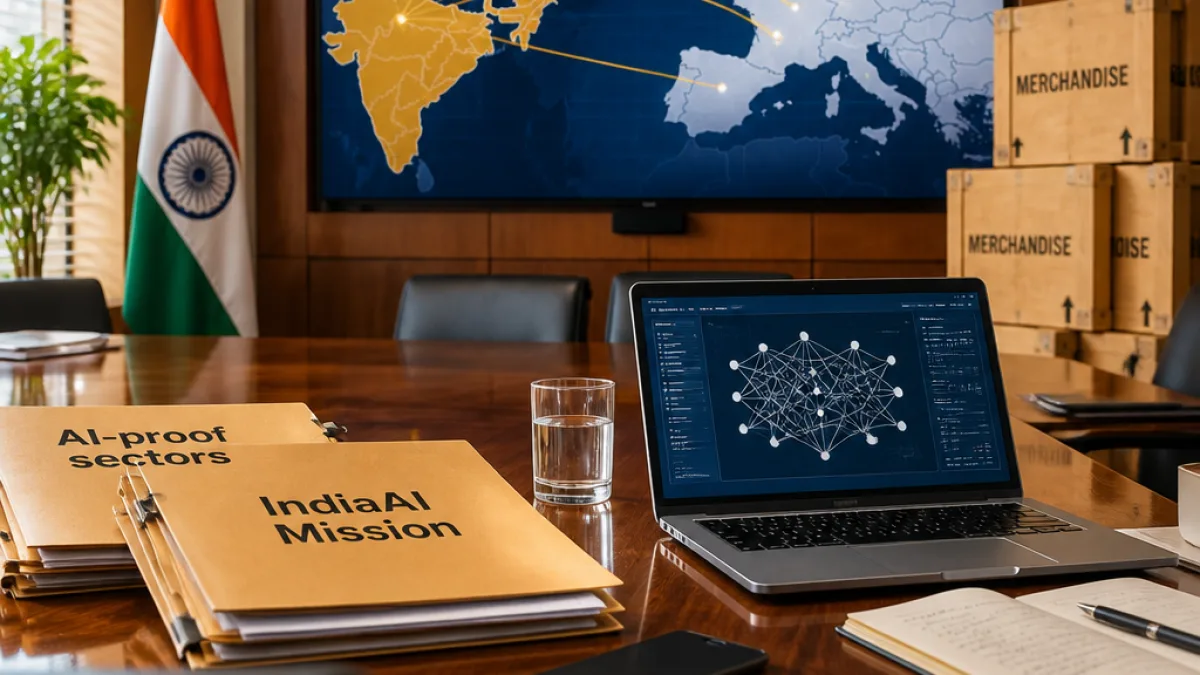
India’s commerce and industry ministry is working to identify sectors that are relatively resistant to displacement by artificial intelligence, commerce and industry minister Piyush Goyal said, signalling a policy focus that pairs labour-market concerns with the government’s broader AI strategy.
What the government said and why it matters
Goyal made the remark during a late Friday night (India time) press briefing while on an official visit to Germany and the Netherlands. He framed the effort as part of a response to worries about AI’s potential impact on employment, and as a way to highlight areas where India could preserve or extend competitive advantage.
“That is an idea that I thought is important in the fast-changing technological landscape around us. And I personally feel many areas where we can take global leadership, given the huge skill and talent that India has and the youthful population,” said Piyush Goyal.
Goyal said certain traditional and culturally rooted activities are examples of work less likely to be automated, mentioning handicraft handloom, culinary strengths and tourism as areas where human skill remains central. He connected that argument to the government’s job and export priorities.
IndiaAI Mission and indigenous foundation models
The minister reiterated the government’s ongoing investments in AI research and capacity building. India has launched the IndiaAI Mission with an allocation of ₹10,371.92 crore, and the programme is also supporting 20 indigenous foundation model projects. Goyal named four projects the government is supporting: Sarvam AI, Gnani.AI, BharatGen and Avataar AI.
- IndiaAI Mission: ₹10,371.92 crore allocation
- Foundation model support: 20 indigenous projects, including Sarvam AI, Gnani.AI, BharatGen and Avataar AI
- Policy aim: identify AI-resistant sectors while promoting skills and export growth
Global outreach and trade context
As part of his trip, Goyal said the government will ask India’s embassies and high commissions to encourage greater Indian participation in international conferences, seminars, exhibitions and fairs on AI, startups and semiconductors. He presented this outreach in the context of India’s merchandise trade in September, which the commerce ministry reported as follows:
| Indicator | Value |
|---|---|
| Merchandise exports (September) | $44.4 billion (up 23% year-on-year) |
| Merchandise imports (September) | $74.61 billion (up 8% year-on-year) |
| Trade deficit (September) | $30.21 billion (narrowed from $33 billion a year earlier) |
Goyal linked a focus on AI-proof sectors to India’s broader economic priorities, arguing that strong goods exports are key to growth and that protecting or cultivating sectors that rely on uniquely human skills can support livelihoods across India’s population of 1.4 billion.
Implications for Indian workers, firms and policymakers
The minister’s comments reflect two simultaneous policy tracks: support for domestic AI capability through funding and foundation models, and targeted protection or development of sectors where automation is less likely to displace large numbers of jobs. For Indian workers and companies, that means government attention may focus on:
- channelled funding and partnerships for indigenous AI projects supported under the IndiaAI Mission;
- skills and workforce strategies aimed at sectors identified as AI-resistant or requiring human-led expertise (for example, artisanal crafts, culinary and tourism-related services, as cited by the minister); and
- commercial diplomacy through embassies to secure market access and partnerships in AI, semiconductors and startup ecosystems.
The commerce ministry’s approach places AI policy alongside trade and export objectives. It also underscores that the government sees AI both as a technology to be cultivated domestically and a factor that must be managed to limit social disruption.
Goyal’s statements are part of public briefings from his visit to Europe and reiterate official figures and named programmes.