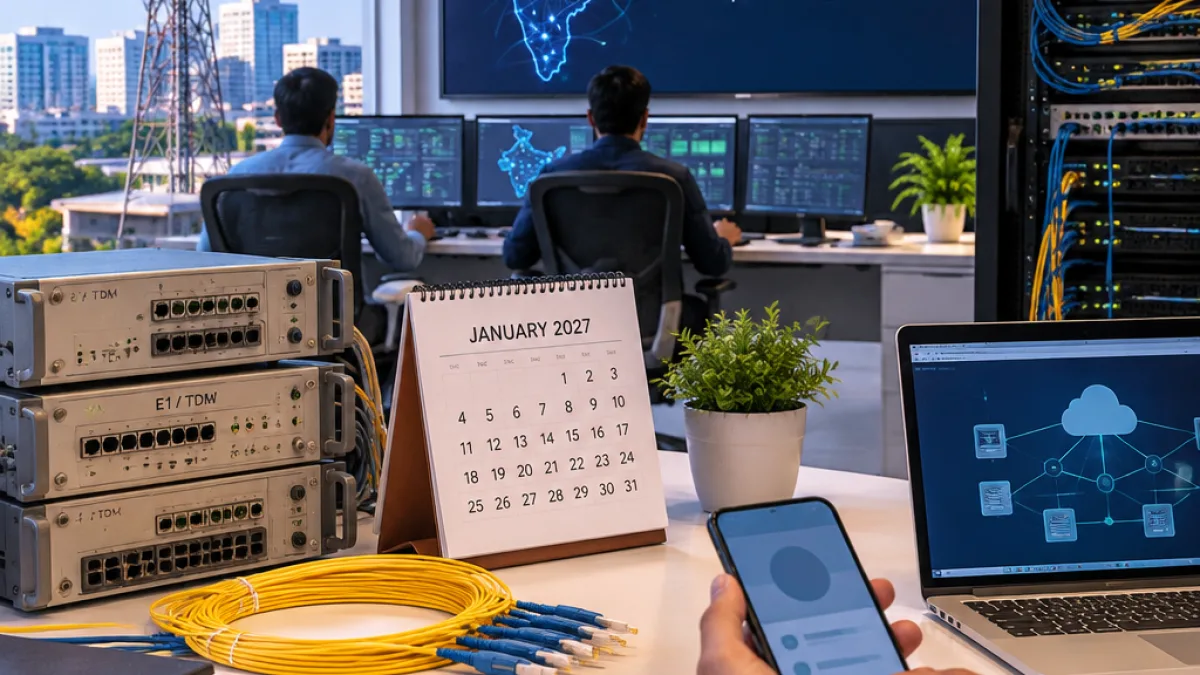
India’s telecom networks will begin a phased shift to Internet Protocol (IP)-based interconnection from 1 January 2027 under amendments notified by the Telecom Regulatory Authority of India (TRAI). The changes will govern how telecom service providers hand over and receive traffic between their networks, with the regulator aiming to modernise interconnection arrangements and improve operational efficiency.
Under the Telecommunication Interconnection (Third Amendment) Regulations, 2026, every new point of interconnection (POI) created after the rules take effect must use IP technology. Existing POIs based on E1/Time Division Multiplexing (TDM) systems will not be required to change immediately. Instead, operators will have to migrate them to IP-based interconnection in a phased manner over three years.
What changes for telecom operators
Points of interconnection are the network locations where traffic is exchanged between telecom providers. The revised framework also moves the sector away from the existing Long Distance Charging Area (LDCA) and Short Distance Charging Area (SDCA) levels towards a Licensed Service Area (LSA)-level structure.
Telecom providers will be allowed to mutually agree on the locations used for handing over and receiving traffic. Existing traffic measured in Minutes of Usage (MoUs) at LDCA- and SDCA-level POIs will have to move to LSA-level POIs within the same three-year transition period. Once the migration is complete, telecom traffic will be handed over or received at LSA or service-area-level POIs.
| Requirement | Timeline |
|---|---|
| New points of interconnection must be IP-based | From 1 January 2027 |
| Existing E1/TDM-based POIs must migrate to IP | Within three years, in phases |
| LDCA/SDCA-level traffic must move to LSA-level POIs | Within three years |
Capacity rules for IP networks
The amendment introduces a framework for calculating the maximum call-handling capacity of IP-based POIs. Capacity will be assessed using the number of concurrent sessions that a POI can handle and the available link bandwidth. Operators must continue to meet the prescribed Quality of Service standards under TRAI’s regulations.
TRAI said the move to LSA-level interconnection is intended to simplify network routing, improve the management of scarce numbering resources, reduce latency and strengthen service reliability. For customers, the most visible effect is expected to come through network-level improvements rather than a new consumer-facing service. The amendment does not announce any change to telecom tariffs, recharge plans or subscriber benefits.
The transition will require operators to coordinate their network upgrades over the three-year period while maintaining communication between subscribers on different networks. The phased approach means that existing systems can continue operating during the migration, but all new interconnection points created after 1 January 2027 will have to follow the IP-based framework.
- New POIs: must use IP-based interconnection from 1 January 2027.
- Existing infrastructure: E1/TDM-based POIs have three years to migrate in phases.
- Traffic handover: arrangements will move from LDCA/SDCA levels to LSA or service-area-level POIs.