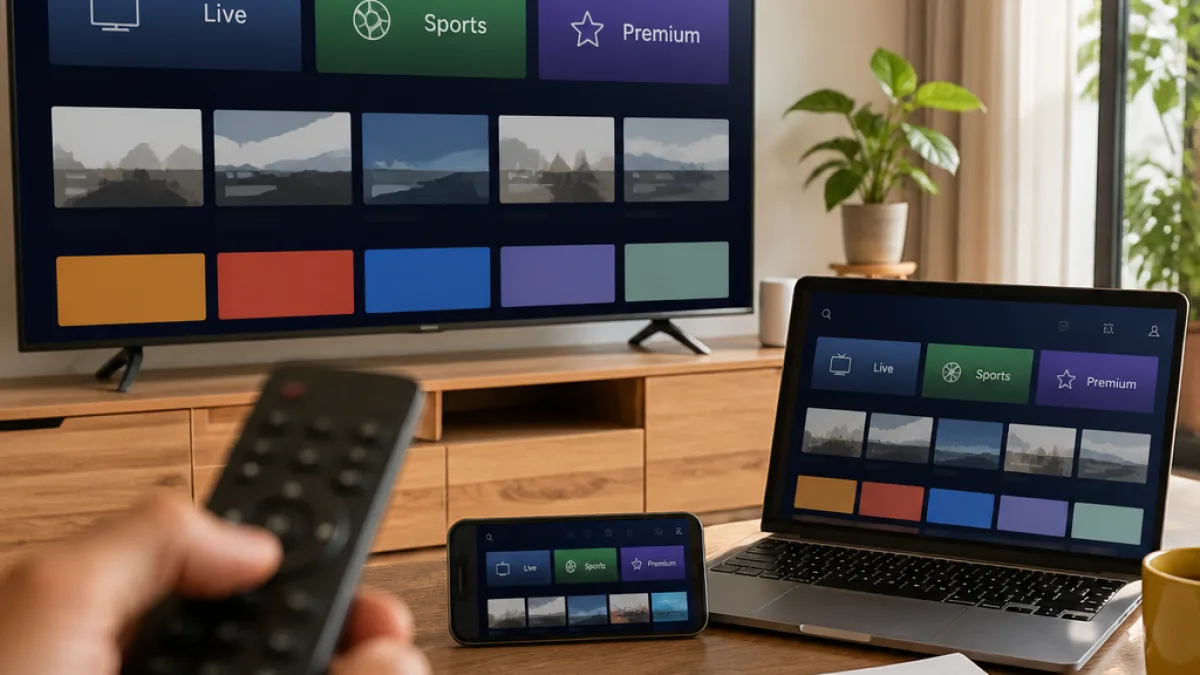
JioHotstar is the streaming platform created by merging Reliance’s JioCinema with Disney’s India streaming and television operation. The tie-up was completed with the joint venture’s closing in November 2024, and the combined consumer app went live on 14 February 2025.
What JioHotstar is and how it earns
Reliance and Disney consolidated distribution reach, content library and sports rights under a single brand. The business model reported in an analysis published on 24 October 2026 lays out a hybrid approach: subscription revenue, advertising, sports monetisation and Connected TV opportunities. Reliance’s capital backing — an ₹11,500 crore investment into the JV at a post-money valuation of roughly ₹70,352 crore — underpins a platform strategy that aims to monetise a very large user base rather than rely on a single revenue stream.
- Scale: the app had crossed 1 billion+ Google Play downloads and reported 450 million+ monthly active users as of January 2026.
- Content: the catalogue spans films, television, regional content and international titles; the JV announced a regional content push, including a stated commitment of ₹4,000 crore over five years for South Indian content (announced December 2025).
- Revenue mix: subscription tiers, advertising inventory and sports monetisation are the core levers.
Pricing tiers and subscription structure
The published subscription structure shows multiple monthly, quarterly and annual price points across three named tiers. The exact tier prices reported are:
| Tier | Prices (monthly / quarterly / annual) |
|---|---|
| Mobile | ₹79 / ₹149 / ₹499 |
| Super | ₹149 / ₹349 / ₹1,099 |
| Premium | ₹299 / ₹699 / ₹2,199 |
These tiers, effective 28 January 2026 according to the report, reflect a graduated offering aimed at capturing low-ARPU mobile subscribers while providing higher-priced plans for multi-device and premium viewers.
Financial snapshot and the monetisation challenge
The analysis cites JioStar FY26 consolidated figures disclosed at Reliance Industries’ AGM: revenue ₹34,917 crore, EBITDA ₹5,842 crore and net profit ₹3,434 crore. Those headline numbers indicate the JV is generating substantial top-line sales and reported profit at the entity level, but the underlying question the report frames is whether the combined app can sustainably convert its vast reach into higher per-user revenue.
For Indian viewers and industry observers, the key elements to watch are how JioHotstar balances free, ad-supported consumption with subscription growth, how it leverages premium sports rights and how the platform allocates its sizeable regional content investment. The multi-tier pricing and the scale metrics posted — downloads, monthly active users and content hours — are central to the strategy articulated in the file.
The merged platform’s approach signals a broader trend in India’s OTT market: consolidation of distribution and inventory under a hybrid commercial model that blends subscriptions, advertising and event-driven monetisation rather than relying on a single revenue source.