The Indian government expects the country’s space economy to expand sharply as private companies take up roles that until recently were the preserve of the Indian Space Research Organisation (ISRO). IN-SPACe — the Indian National Space Promotion and Authorisation Centre — told delegates at a Viasat event that demand for low Earth orbit (LEO) satellites for internet and Earth observation, together with additional launch capacity, will support faster growth.
Private participation and launch capacity
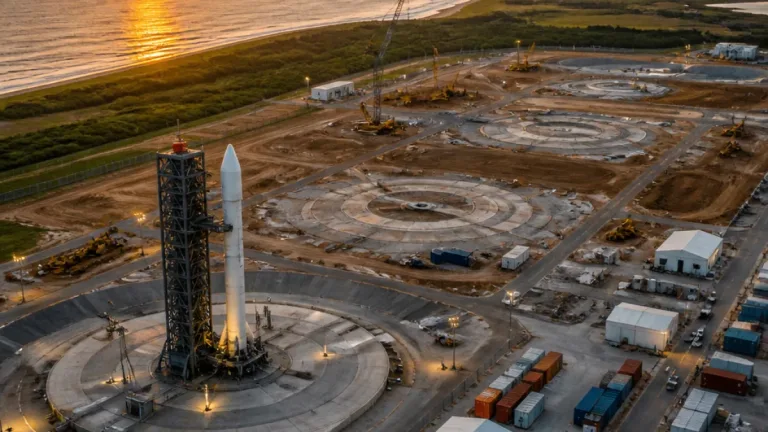
Dr Vinod Kumar, Director of the Promotion Directorate at IN-SPACe, said India is positioned to capture growing demand for LEO services and that a new Small Satellite Launch Vehicle (SSLV) launch pad at Kulasekarapattinam in Tamil Nadu will augment national launch capacity. He noted that the government’s 2020 reforms have allowed private firms to perform end-to-end activities that were previously handled only by ISRO.
“See, demand for LEO satellites is rising for low-orbit internet and earth observation. We have SSLV, and we have augmented launch capacity with a new launch pad at Kulasekarapattinam in Tamil Nadu. So that business will stay in India,” said Dr Vinod Kumar.
IN-SPACe acts as a single-window regulator and promoter for non-government entities in the space sector, offering authorisations and facilitation for private companies to undertake space-related activities.
Scale and ecosystem
The organisation highlighted the rapid expansion of India’s space ecosystem by citing current counts of organisations operating in the sector. IN-SPACe reported more than 450 space startups, over 250 other registered startups, more than 300 micro, small and medium enterprises (MSMEs), and over 50 large space companies. The present valuation of India’s space economy stood at USD 8.4 billion, representing about 2 percent of the global space market, and the stated aim is to grow this to USD 44 billion over the coming years.
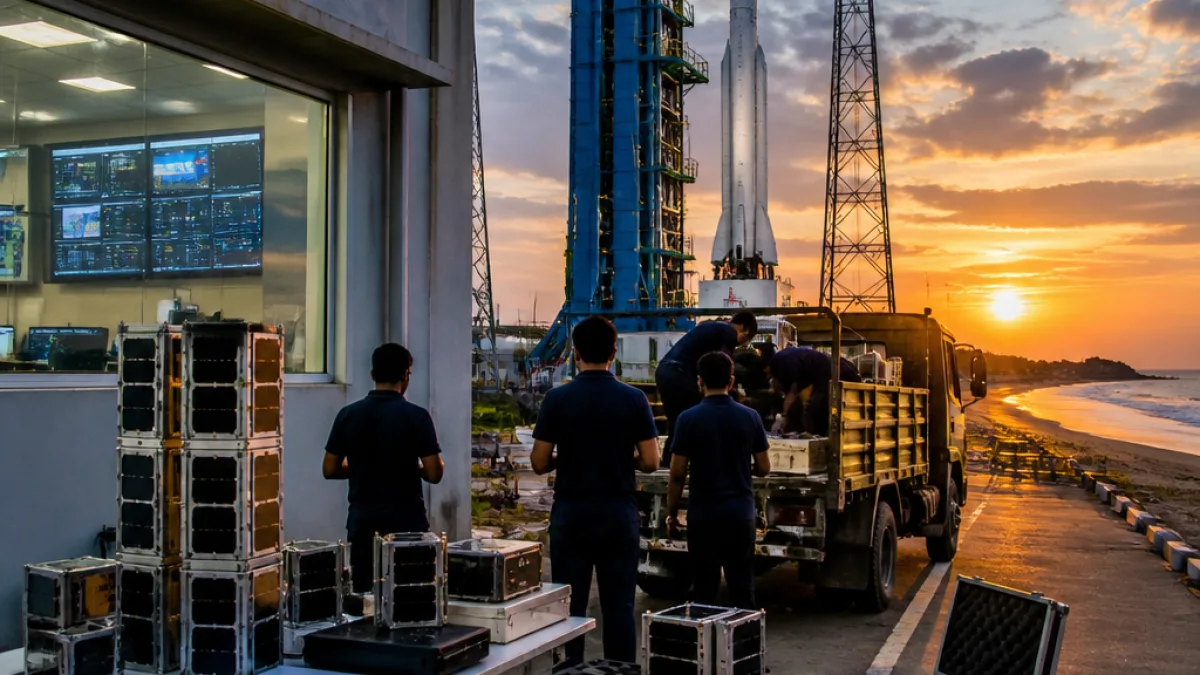
The combination of indigenous small-satellite demand, domestic launch capability through SSLV, and a single-window regulatory framework is intended to keep more of the satellite design, manufacturing and launch chain inside India.
- Current space economy: USD 8.4 billion
- Target space economy: USD 44 billion
- Infrastructure boost: SSLV launch pad at Kulasekarapattinam, Tamil Nadu
- Industry counts cited by IN-SPACe: 450+ space startups; 250+ other registered startups; 300+ MSMEs; 50+ large space companies
| item | figure |
|---|---|
| Current valuation | USD 8.4 billion |
| Target valuation | USD 44 billion |
| Space startups | 450+ |
Dr Kumar emphasised that the reforms initiated in June 2020 were a turning point: they enabled private companies to carry out complete space projects rather than only act as vendors to ISRO. IN-SPACe’s role as regulator and promoter is central to that transition, providing authorisation and facilitation to non-government players.
If the projected expansion materialises, it would reflect a substantial change in India’s space industrial base, with implications for satellite manufacturing, launch services, downstream data and connectivity businesses, and for startups seeking to build services that run on LEO infrastructure.