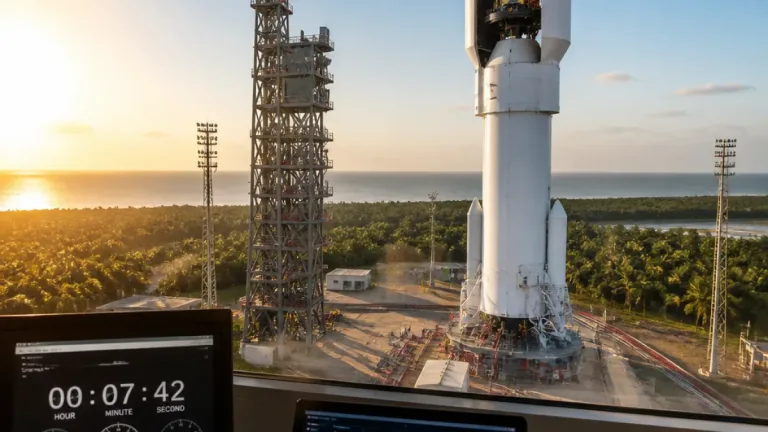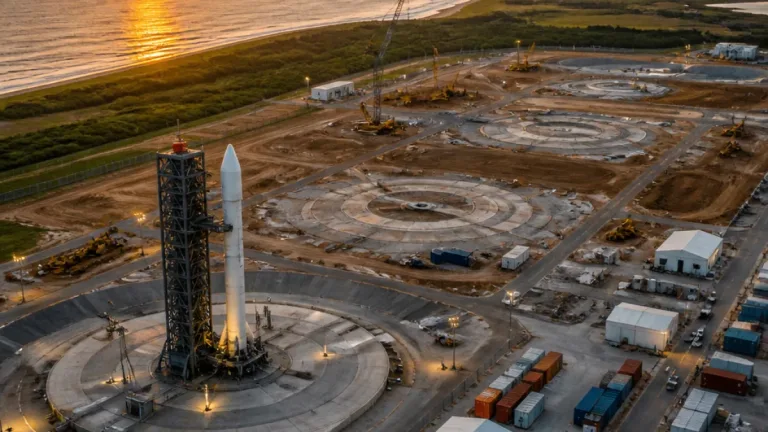
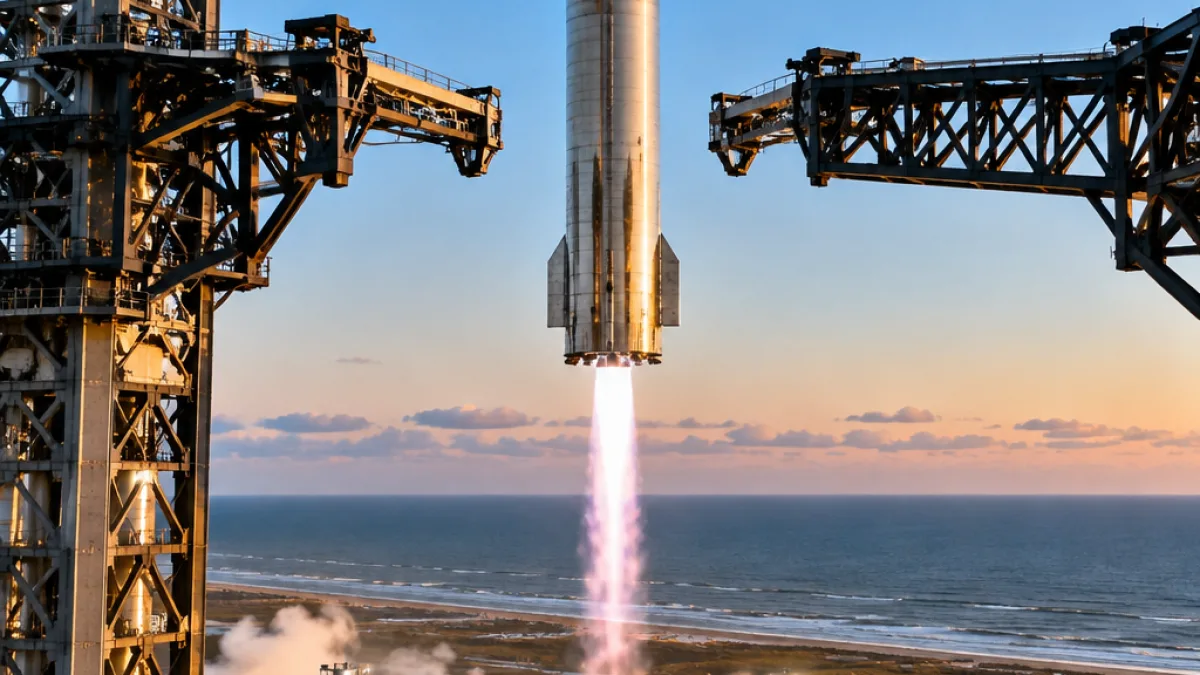
SpaceX has recovered the upper stage of Starship for the first time, completing a major test of the company’s plan to make both sections of its heavy-lift rocket reusable. The spacecraft returned from orbit and was secured by the large mechanical arms fitted to the launch tower after a mission lasting about 22.5 hours.
The recovery took place at SpaceX’s Starbase facility in Boca Chica, Texas, on Saturday local time, corresponding to 15 November 2026 in India. Starship hovered close to the tower before descending between the arms, which SpaceX informally calls “chopsticks”. Staff at the site cheered as the vehicle was captured.
A partial recovery on Starship’s 15th test
The mission was the 15th test flight of the Starship system and the first attempt to recover its upper and lower sections during the same flight. The 124-metre vehicle launched from Starbase at 4:47 pm local time on Friday, which was early on 14 November IST. Its upper section, known as the Ship, continued into space after the booster’s recovery attempt was abandoned.
The Super Heavy booster was expected to return to the launch site around six and a half minutes after liftoff. Instead, an automated abort redirected it towards the ocean. The booster hovered above the water before exploding. Musk later attributed the failure partly to the vehicle being “slightly low on fuel”. SpaceX has also said that the flight’s guidance, navigation and control system determined that the booster was not correctly positioned for a safe catch.
The upper stage followed a different trajectory. Once in space, it deployed 26 satellites for SpaceX’s Starlink constellation and completed 14 orbits around Earth. It then re-entered the atmosphere, slowed down and approached the launch tower under engine power before the mechanical arms took its weight.
Why the catch matters
SpaceX has already caught the Super Heavy booster on three earlier test flights, but this was the first successful attempt involving the Ship. Recovering the upper stage is a harder engineering task because it must survive atmospheric re-entry from orbital speed before reaching the launch site with enough control and precision for the tower to secure it.
| Mission detail | What happened |
|---|---|
| Test flight | Starship’s 15th |
| Time in space | About 22.5 hours |
| Orbits | 14 around Earth |
| Starlink payload | 26 satellites deployed |
| Upper stage | Captured by the launch tower |
| Super Heavy booster | Automated abort followed by an ocean explosion |
For SpaceX, the result demonstrates that the upper stage can return to the launch complex rather than being lost after a flight. The company’s long-term objective is to reuse both sections repeatedly, reducing the need to manufacture a new vehicle for every mission and improving the frequency of launches. The latest test does not complete that objective, since the booster was not recovered, but it establishes the first successful tower capture of the Ship.
The test is also relevant to the wider launch industry and to India’s space technology ecosystem. A working recovery system could influence the cost and operating model of future orbital missions, including the deployment of large satellite constellations. Starlink’s 26-satellite deployment during this flight also showed how SpaceX is combining vehicle testing with satellite delivery. However, the successful recovery itself does not represent an announcement of Starlink availability or a service launch in India.